
What to check about a property's location before you buy
A listing shows the kitchen, not the flood map. These are the location checks that matter when you buy a US home, each with why it matters, what the data can and cannot tell you, and what to ask next. The Property Location Report gathers all of them for one address, every figure sourced.
US addresses only. Every figure names its source.
The checks
Flood zone
See the FEMA flood zone at a US address, how far the nearest Special Flood Hazard Area is, and what each zone means, on a map, from FEMA's National Flood Hazard Layer.
Read moreWildfire risk
How a US county ranks for wildfire risk and how many of its buildings are exposed, from USDA Wildfire Risk to Communities, plus the wildfire rating in FEMA's National Risk Index.
Read moreCrime
Offenses reported to the police agencies that cover a US address, from the FBI's Crime in the United States, with state rates for comparison. An agency's statistics, not a map of crime near a home.
Read moreSuperfund sites
EPA Superfund sites near a US address with their list status and boundary distance, plus leaking-underground-tank records and regulated facilities. Proximity is not contamination.
Read moreWetlands
Mapped wetlands near a US address from the USFWS National Wetlands Inventory, with their type, size and imagery year. A map reading, not a jurisdictional wetland determination.
Read moreSchools
The public schools nearest a US address with their distances on a map, and the school district the address falls in, from the National Center for Education Statistics.
Read moreWhat a report looks like
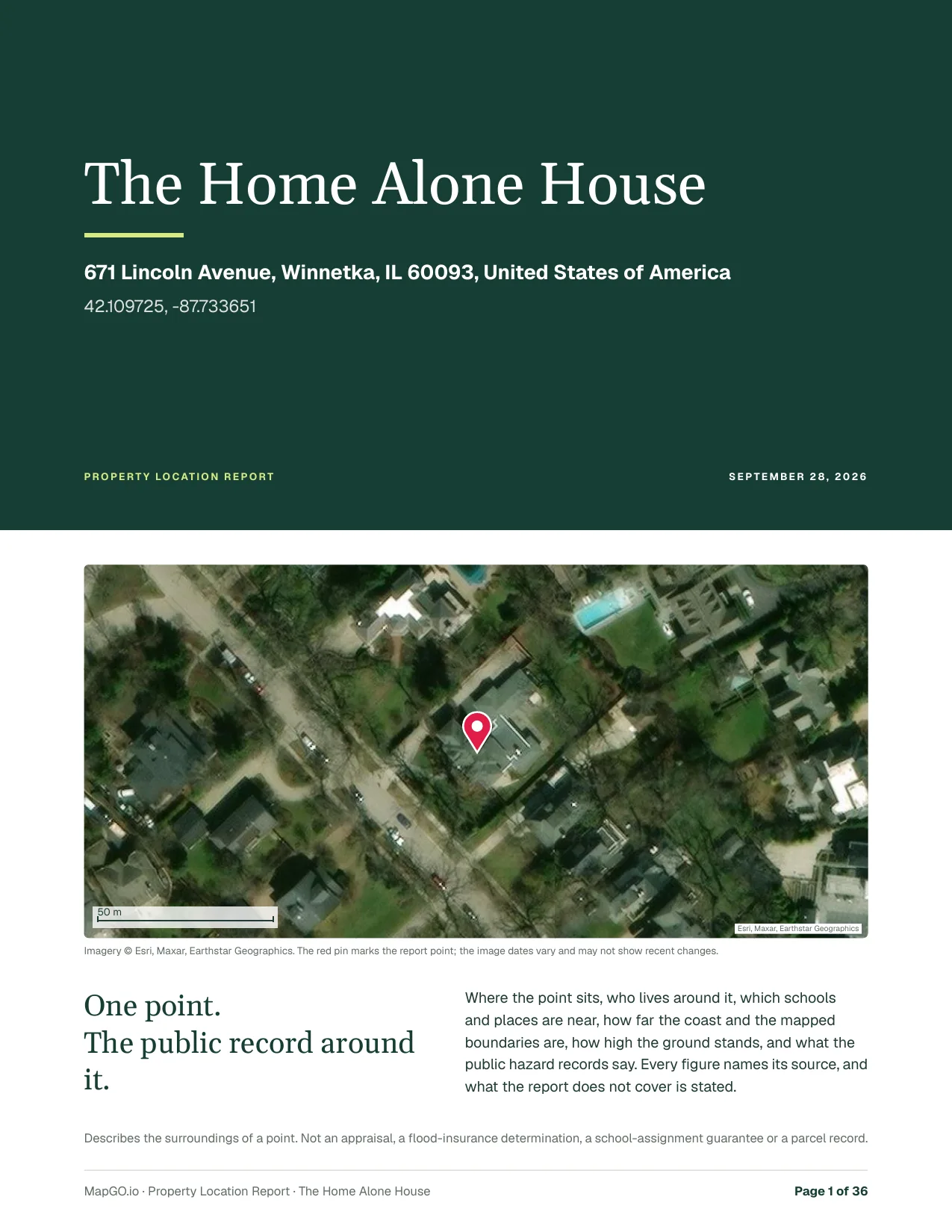
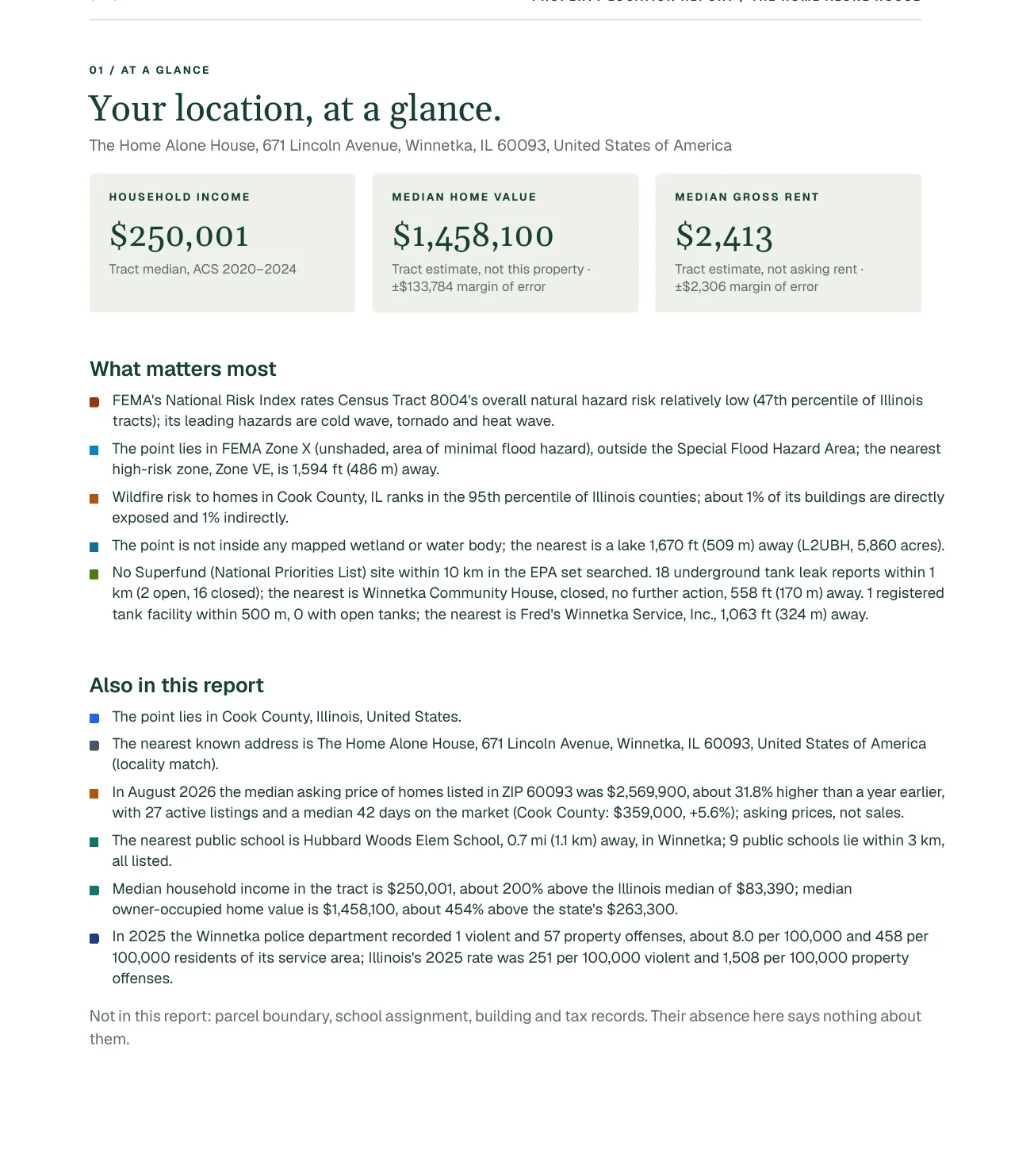
A real report for a well-known address: a cover, an at-a-glance page that puts the matters that count most first, then a section for each check with its source, a map or chart, and a plain note on its limits. Select a page to see it full size.
A starting point, not a verdict
The report reads public data for a point. It is not a flood determination, an insurance rating, an environmental assessment or an inspection, and it never calls a place safe. Use it to know what to ask the seller, the lender, the insurer and the local authorities.