
Superfund and EPA sites near any US address
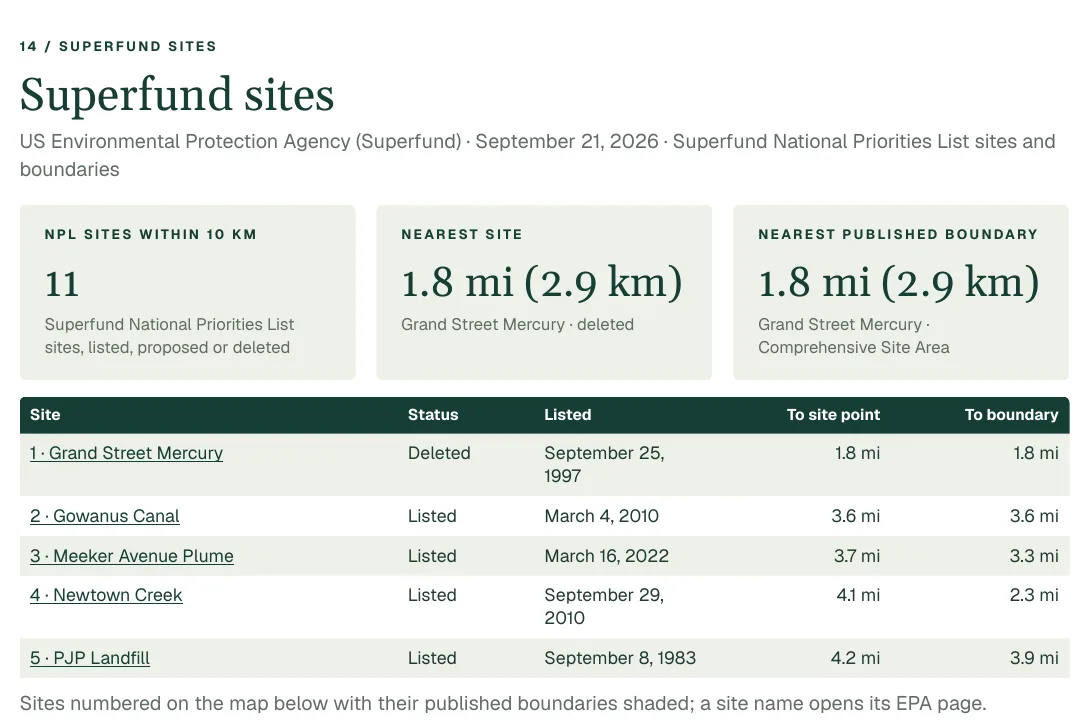
A listed cleanup site nearby is something a buyer wants to learn before closing, not after. The Property Location Report lists the EPA Superfund sites close to an address, with their status and distance, then the underground-tank records and regulated facilities around it.
US addresses only. Every figure names its source.
Why it matters when you buy
It is something to ask the seller about
A site nearby can bear on disclosure, on a lender's environmental review and on how the neighbourhood is seen. Finding it early gives you time to ask what was cleaned up and what remains.
Status tells you more than distance
The report names the list status: listed, deleted after cleanup, or proposed. A site deleted after meeting EPA's criteria is a different thing from one still being worked on.
Tanks and facilities fill in the picture
Beyond Superfund, the report shows leaking underground tank records within 1 km, tank facilities within 500 m and regulated facilities nearby, each with the distance and how well the location is known.
What the report shows
- EPA National Priorities List sites nearby, with list status, distance and, where published, the distance to the site boundary or 'inside'.
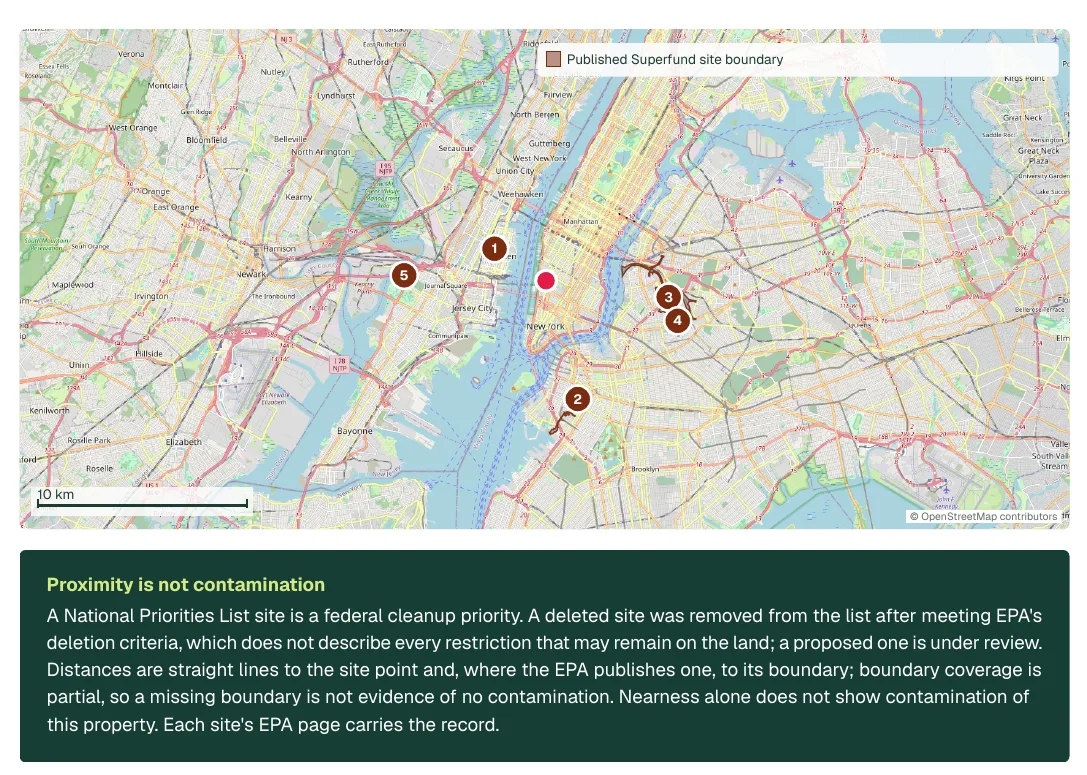
- A map of the sites and their published boundaries.
- Underground storage tank leak records within 1 km, and tank facilities within 500 m.
- Regulated facilities from EPA ECHO, up to ten of the nearest, with compliance status and how precisely each is located.
Source: U.S. EPA: Superfund (NPL), UST Finder and ECHO. Each family names its own dataset on the sources page. The tank records come from state data, mostly of 2018 to 2019, and the report says so.
More from the same report
Pages from a real sample report. Select an image to see it full size.
What it cannot tell you
- Proximity is not contamination. A site being near says nothing about the air, soil or water at the property.
- A leak report is history, mostly from 2018 to 2019. It is never a current leak, and a tank is never a leak.
- A facility located by ZIP or county centre is marked approximate. The report never calls a site a polluter or toxic.
- Zero listed is a result: it means none in the EPA data searched, not that nothing was ever there.
Before you buy
The report is a starting point. These are the questions it points you to.
- 1Is the site on the list, deleted, or proposed, and how far is its boundary?
- 2Ask the seller and the lender whether an environmental assessment was done.
- 3Read the EPA's own page for the site to see what was cleaned up and what is monitored.
- 4For older commercial buildings nearby, ask about past use.
Questions
How do I find out if a Superfund site is near a house?
Enter the address in the Property Location Report. It lists nearby EPA Superfund sites with their status and distance, and the EPA's own pages give the detail on each.
Does a nearby site mean the property is contaminated?
No. The report only places the site relative to the address. It makes no claim about conditions at the property.
What does 'deleted' mean?
A deleted site was removed from the list after meeting EPA's deletion criteria, usually after cleanup. It may still be monitored.
More in the same report
Wetlands
Mapped wetlands near a US address from the USFWS National Wetlands Inventory, with their type, size and imagery year. A map reading, not a jurisdictional wetland determination.
Flood zone
See the FEMA flood zone at a US address, how far the nearest Special Flood Hazard Area is, and what each zone means, on a map, from FEMA's National Flood Hazard Layer.
Crime
Offenses reported to the police agencies that cover a US address, from the FBI's Crime in the United States, with state rates for comparison. An agency's statistics, not a map of crime near a home.
Also: Flood zone, Wildfire risk, Crime, Wetlands, Schools.